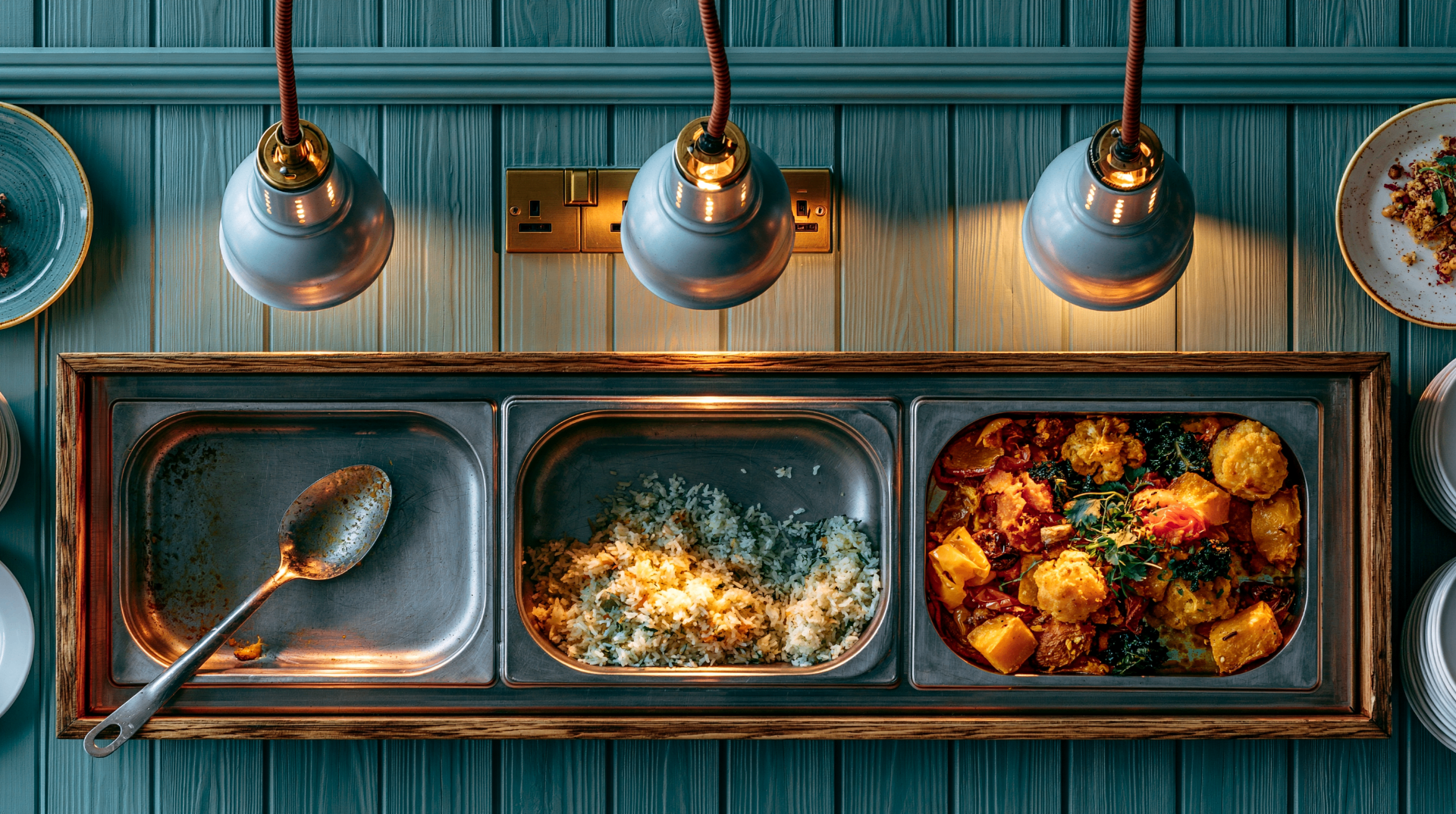
Walk into a buffet at midday and you are paying for the peak. Full trays, everything replenished, the room busy. It is the best the line will look all day, and the price reflects it.
Walk in near the end of service and you are looking at a different proposition. Less choice. Still plenty of food. Same kitchen, same trays, a fraction of the value captured — because in about forty minutes, whatever is left stops being food and starts being a disposal cost.
Most people assume late means scraps. Sometimes it does. But the reason it often doesn't comes down to how a buffet kitchen actually runs, and that is worth understanding whether or not you ever buy a box from us.
What a kitchen is doing in the last hour
A buffet is a production line working against a forecast. The kitchen cooks to expected covers, holds food at temperature in gastronorm pans, and tops up the line as trays run down.
The critical decision is when to stop cooking. Replenish too long and you finish service with trays of food nobody paid for. Stop too early and a paying customer walks up to an empty pan, which is the one outcome a floor manager genuinely cannot afford.
So a well-run kitchen stops replenishing somewhere before the doors close and lets the line ride down. In a hotel with tight production planning that might be half an hour out. In a club carvery on a busy Sunday it might be much later, because the cost of running out on a paying diner outweighs the cost of one more tray.
That gap — replenishment stopping, service continuing — is the window this post is about.
Why the food in that window is not what you think
Two things about how buffet food is held explain why the last half hour is better than its reputation.
Hot-held food is cooked once, not gradually degraded. It goes onto the line at temperature and stays there. A curry, a biryani, a braise or a roast vegetable tray is largely unchanged between the first service and the last. Some things genuinely suffer — anything fried loses its crunch within twenty minutes, and delicate greens wilt — but the substantial dishes, the ones that actually feed you, hold well. Slow-cooked food is designed to sit.
The line thins unevenly. People eat in a predictable order. The prawns go first, then the carvery, then whatever the room's crowd favours. What survives to the end is not the worst food, it is the least-fashionable food — the dhal, the rice, the roasted vegetables, the sides that nobody builds a plate around but everyone eats. If you are feeding a family rather than treating yourself, that distinction matters less than the price does.
What you give up
There is a real trade, and pretending otherwise would be insulting.
You lose choice. A dozen dishes at noon might be four or five at close. You cannot plan a meal around a specific thing and expect it to be there.
You lose predictability. Two visits to the same venue on different days will not look the same. A quiet Tuesday leaves more than a busy Sunday.
And the busier the format gets, the thinner the end of service. Buffet dining is having a moment in Australia, largely because a fixed price removes bill shock at a time when nobody wants a surprise at the end of a meal. That is good for venues. It also means fuller rooms, and fuller rooms mean less left at close.
So the honest framing is not "late is secretly better." It is: you are trading choice for value, and whether that is a good trade depends entirely on what you want from the meal.
If you are celebrating something, go at peak and pay for peak. If you are feeding a household on a budget on a Wednesday, choice is worth less to you than the price is.
The bit that gets thrown away
Here is the part most diners never see. When service ends, hot-held food cannot be cooled and re-served. Food safety rules exist precisely because that is where things go wrong, and no responsible kitchen is going to chill a bain-marie tray and bring it back tomorrow.
It also cannot easily be donated. The large food rescue charities work at pallet scale, with refrigerated logistics, and they are set up for packaged and chilled goods rather than a tray of hot curry at 2:45 on a Sunday. That is not a criticism of them — it is a mismatch of format.
Which leaves the bin. Not because anyone wants it there, but because at the end of service there is no mechanism to get it anywhere else.
Where Heaped fits
That missing mechanism is the whole reason we are building Heaped.
The idea is simple: near the end of service, you reserve a box in the app, walk in, and fill it yourself from what is on the line. You see the food before you pay. You pack what your household will actually eat, not what somebody else decided to put in a bag. Choice, not a mystery bag.
To be straight with you: Heaped is not running yet. We are still signing our first venue, and there is nothing to download today.
What there is, is a form. Tell us your suburb and what you would actually eat, and that tells us where to open first.
Register your interest at heaped.app
And if you know a buffet that finishes service with food still on the line — a club carvery, a hotel spread, a family restaurant that does it properly — tell us about it. Venue tips are the most useful thing anyone sends us.
If this framing resonates, our earlier post on feeding a family in Sydney when the grocery bill keeps climbing walks the same territory from the shopping-trolley end.
Eat a buffet. Reduce food waste.
Launching in Sydney soon
Be first to grab a buffet box.
Register your interest and we'll let you know the moment there's good food, heaped high, near you.
Register your interest →